
The Dover Demon: Three Teenagers, One Night, and Nothing Since
In April 1977 three teenagers in Dover, Massachusetts described the same creature within about 25 hours. Nobody has explained it, and nobody has seen it since.
Updated July 31, 2026
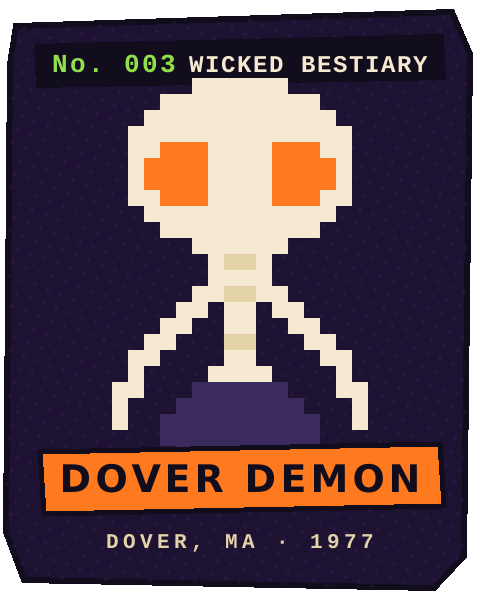
Most cryptid stories have a long tail — decades of sightings, blurry photographs, a tourist industry. The Dover Demon has none of that. It has about twenty-five hours in April 1977, three teenagers, and then nothing, ever again.
That's what makes it the most interesting unexplained thing in Massachusetts.
What the three of them said
Bill Bartlett, seventeen, was driving on Farm Street with two friends when his headlights caught something on a low stone wall. He described a figure roughly the size of a small child with an enormous watermelon-shaped head, glowing orange eyes, no nose or mouth that he could see, and long spindly fingers gripping the stones. Skin like wet sandpaper, peach-coloured. His friends were looking elsewhere and saw nothing.
He went home and drew it. Under the drawing he wrote that he swore on a stack of Bibles he had seen it.
John Baxter, fifteen, was walking home later that same night, in a different part of Dover. He saw a figure approaching on the road, assumed it was someone he knew, and called out. It ran. He followed it down a gully, and it stopped on the far bank against a tree — where he got a clear look at a figure with a large head and thin limbs, feet shaped around the base of the trunk. He left quickly.
He also drew it, before either boy knew the other had seen anything.
Abby Brabham, fifteen, was in a car with her boyfriend the following night on Springdale Avenue. She described a seated figure with a large head and bright eyes. Her boyfriend, driving, said he saw nothing but did not dispute that she had.
Three teenagers. Three locations. Roughly one day. Independently consistent drawings of an anatomy none of them had any reason to invent — because in 1977, in Dover, Massachusetts, there was no template for this thing. It doesn't look like a Grey. It doesn't look like Bigfoot. It doesn't look like anything that was in circulation.
What the record actually supports
This is where these stories usually collapse, and this one mostly doesn't.
The witnesses were interviewed separately and their accounts held. The local police chief regarded them as credible kids rather than pranksters. The name "Dover Demon" was attached afterwards by a cryptozoologist, not by the teenagers — they never called it anything.
Nobody made money. In the decades since, none of the three has recanted, and none has built a career on it. Bartlett, who became a professional artist, has said consistently that he saw something and doesn't know what it was. That is the least commercially useful position available.
And nothing followed. No second wave, no photographs, no footprints, no further sightings anywhere. Genuine hoaxes tend to grow. Genuine misidentifications tend to recur, because whatever was misidentified is usually still around.
The explanations, and why none quite land
A foal. Newborn horses have disproportionately large heads and impossibly thin legs, and Dover is horse country. It's the strongest candidate. But a foal has a muzzle, and all three described the absence of one.
A sick or orphaned moose calf. Same shape argument, same problem, plus moose were scarce that far into eastern Massachusetts in 1977.
An owl. Explains the eyes and the perched posture; explains nothing about the limbs.
A hoax by the teenagers. Requires three fifteen-to-seventeen-year-olds in different parts of town to coordinate an invention with no payoff, and then maintain it for nearly fifty years without one of them cracking.
Every explanation accounts for part of it. None accounts for all of it. That's the honest state of the case, and it's more interesting than either "monster confirmed" or "obviously a horse."
Why Dover, and why then
Dover is an affluent, wooded, low-density town southwest of Boston — the kind of place with stone walls, horse properties and very little street lighting. In April, the trees are still bare and the nights are cold.
It also sits at the northern edge of the region that would later be marketed as the Bridgewater Triangle, a designation invented by the same cryptozoologist who named the Dover Demon. Treat that connection as branding rather than evidence: the Triangle came after, and it exists to gather unrelated events under one heading.
The Dover Demon doesn't need the Triangle. It's strange enough on its own, and unusually well-behaved as a mystery: small, bounded, well-witnessed, and completely unresolved.
Seeing it for yourself
There is nothing to see. Farm Street and Springdale Avenue are ordinary residential roads in a town that has never wanted this story and does not commemorate it. Please don't go looking — these are people's houses, and Dover has been fielding this for half a century.
If you want the region's stranger side with somewhere to actually go, Boston's ghost tours are twenty minutes northeast and considerably better provisioned.
Further reading
Books we drew on, or would if you want the long version.
As an Amazon Associate I earn from qualifying purchases. Bookshop.org links also earn a commission, at no extra cost to you.
Mysterious America — Loren Coleman
By the cryptozoologist who named both the Dover Demon and the Bridgewater Triangle. Read it for the primary accounts rather than the conclusions.
The Haunted Almanac
We check all 50 New England haunted attractions against their own websites, every week. 25 have published 2026 dates so far. Last sweep: September 15.
The ones that matter never announce. Spooky World published twenty-three nights and put them nowhere but its ticket widget; Scary Acres rebuilt its whole site in nine days without a word. We find those and send them to you. Free, and one click gets you out.