
Pukwudgies: New England's Oldest Legend Isn't a Cryptid
The Pukwudgie is Wampanoag tradition, older than any ghost story on this site — and the version sold on ghost tours is a settler rewrite of somebody else's living culture.
Updated July 31, 2026
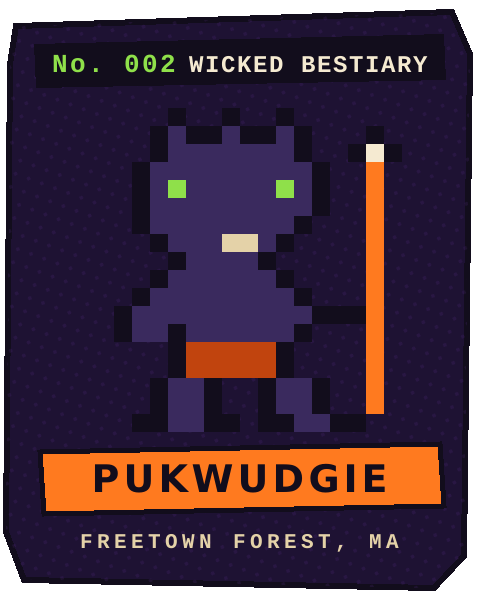
Every other story on this site is a few hundred years old at most. This one is older than the colonies, older than English in this hemisphere, and — importantly — it is not finished being told.
That's the thing most Pukwudgie content gets wrong before it starts.
What the tradition actually holds
The Pukwudgie belongs to Wampanoag tradition, and closely related beings appear under related names among Algonquian peoples across the northeast. They are small — two to three feet is the usual figure — and human in shape. The name is generally glossed as something along the lines of person of the wilderness.
In the Wampanoag telling they are bound up with Maushop, the giant whose actions shaped the land of southeastern Massachusetts and Cape Cod. The relationship between Maushop and the Pukwudgies is not a friendly one, and the details are properly the Wampanoag Nation's to tell rather than a website's to summarise.
What survives consistently is that they are not simple. They are not fairies and they are not monsters. They are beings with their own grievances, capable of help and of serious harm, who were wronged and remember it. That moral texture is the whole point of the figure.
What the tours do to it
The version you will hear on a southeastern Massachusetts ghost tour is roughly: small evil creatures with grey skin live in the Freetown forest, lure hikers to cliff edges, and push them off.
That's a monster. Monsters are simpler than what the tradition contains, and simpler sells.
It's worth naming what's happening there. A living Indigenous tradition gets stripped of its context, reassigned to a specific patch of state forest, given a physical description stable enough to draw, and slotted into a cryptid lineup between Bigfoot and the Dover Demon. The Wampanoag Nation is a federally recognised, contemporary people. Their stories are not unclaimed folklore lying around for repackaging.
Report the legend accurately, and the accurate report includes who it belongs to. That's the whole of it.
Freetown-Fall River State Forest
The forest itself is real and genuinely uneasy, though not for the reasons the tours give.
It covers several thousand acres of scrub oak and pine across Freetown and Fall River, cut through with fire roads and quarries. Part of it is within the Watuppa Reservation, held by the Wampanoag. It is easy to get disoriented in, which is a real and unglamorous explanation for a great many unsettling experiences.
It also carries a documented record of serious crime through the 1970s and 1980s — actual violence, in an actual place, involving actual victims. A good deal of what gets folded into "the forest is cursed" is that history, laundered into something more entertaining. It deserves more care than it usually gets.
The Bridgewater Triangle
The Pukwudgie's modern fame comes largely from being filed under the Bridgewater Triangle — a roughly two-hundred-square-mile area of southeastern Massachusetts, named in the 1970s by cryptozoologist Loren Coleman, the same writer who named the Dover Demon.
The label does what labels do: it gathers unrelated things — Pukwudgie accounts, UFO reports, thunderbirds, the Freetown crimes, Hockomock Swamp — and implies a shared cause by putting a border around them.
Southeastern Massachusetts genuinely does have an unusually dense folklore record. Some of that is the Wampanoag tradition being older and better preserved here than almost anywhere. Some is swamp, which is disorienting and unpleasant to cross at night. None of it requires a triangle.
If you go
The state forest is open and there are marked trails, and it is a decent walk in daylight. Do not go looking for Pukwudgies. Beyond the obvious — you will not find any — parts of the forest are Wampanoag reservation land and treating it as a monster-hunting ground is exactly the behaviour described above.
If you want the region's stranger side with somewhere to actually put your money, the Massachusetts haunted attraction roundup covers what is actually operating this season, and Fall River is also where the Lizzie Borden House takes overnight bookings — a very different kind of strange, and one where the record is not in dispute at all.
The Haunted Almanac
We check all 50 New England haunted attractions against their own websites, every week. 25 have published 2026 dates so far. Last sweep: September 15.
The ones that matter never announce. Spooky World published twenty-three nights and put them nowhere but its ticket widget; Scary Acres rebuilt its whole site in nine days without a word. We find those and send them to you. Free, and one click gets you out.